
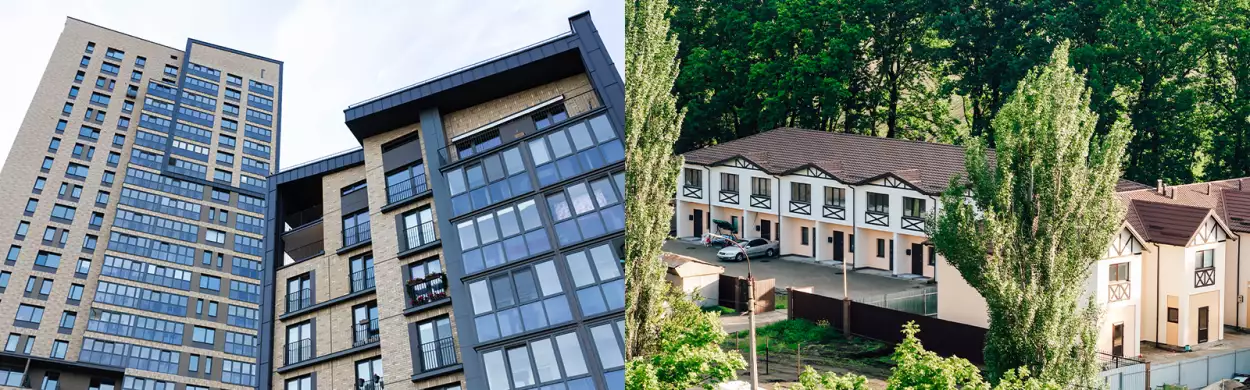

Considering purchasing property in Toronto? Condos and townhouses stand out as leading choices. Making a choice between a condo and a townhouse is a significant decision.
Of course, price, location and lifestyle play a part in your decision. Our team has spent years studying Toronto's real estate market and helping buyers navigate preconstruction condo purchases, giving us firsthand insight into what suits different situations.
This comprehensive guide provides expert insights, current market data, and actionable strategies to help you navigate the condo vs townhouse decision successfully.
Quick Summary
- Toronto's real estate market continues to see strong demand for both condominiums and townhouses, with 18% of newcomers choosing condos and 15% opting for townhouses according to Royal LePage survey data.
- The condo market has experienced drastic growth due to immigration and Toronto's booming job market, while townhouses maintain higher resale values due to their independence and space offerings. As of our latest review, this trend shows no signs of slowing down.
- Both property types serve different lifestyle needs, with condos excelling in urban convenience and security, while townhouses provide greater autonomy and private outdoor space. Your choice ultimately depends on whether you prioritize walkability and low maintenance or ownership flexibility and land ownership.
Popular Housing Choices
According to a survey by Royal LePage, 18% of newcomers in Canada buy a condominium, and 15% opt for a townhouse. While the results appear closely related, the actual property types couldn't be more different from each other [1].
Across Canada, condos and townhouses are the two main property choices that people opt for when buying homes. Both have different benefits and provide unique facilities to the homeowners. The decision of which is best for you will mainly depend on the type of lifestyle that you lead.
That said, while previously it depended solely on whether a family or an individual is buying the house - things have changed. For example, it used to be the case that condos didn't have many amenities. Nor did they have much open space like a townhouse. However, both options are much more accessible than ever before as homes for people of all lifestyles.
Today's preconstruction condos and townhome developments are designed with versatile floor plans and modern amenities that appeal to singles, couples, and families alike.
Let's break down each property option in further detail, starting with condos.
What Is a Condo?
 Condos are residential units that are owned by individuals instead of landlords. Condo units are in buildings or owned as part of a community.
Condo owners only have access to the interiors of the property. The communal area, parks, communal amenities, etc. are usually owned by the Homeowners Association (HOA). As a result, condo owners are subject to HOA fees.
If you're leaning more towards buying a condo, you're not alone. According to our experts at Precondo, the condo market in Toronto has seen a drastic rise as of late due to immigration and the booming jobs market. Learn more about their pros and cons here:
Pros
Here are a few benefits of buying a condominium:
- Maintenance - The maintenance required for a condominium is very minimal. Residents will only have to look after their houses and not the open spaces. The corporation or HOA owns most of the condos as well as the communal and other spaces within the building. However, any condo fees will cover all maintenance work that might be required [2]. Overall, the money spent on maintenance fees is cheaper in a condo.
- Benefits of neighbours - Another added benefit of staying in a condominium is that residents will live around lots of people. Living in a condo is great for building social circles. Plus, during emergencies, having good neighbors can be really beneficial.
- The location - Most of the condos in Toronto are in bustling neighbourhoods. Homes in popular areas tend to have better public transportation, making your condo location convenient for reducing your commute from your home to work.
- Amenities - The number of amenities that a resident gets while staying in a condo is unrivaled. Facilities include gyms, party rooms, rooftop BBQ areas, open and green terraces, meeting rooms and yoga rooms.
- Cost - The cost of staying in condos is cheaper compared to other real estate properties. Usually, fees for maintenance are divided between all the residents and the owners. Therefore, the cost of living in a condo is more affordable for most people.
- Safety - Condos have higher security for residents, as individual units are close together. Also, residents can pay for additional security services and gadgets.
Cons
Living in a condominium is not all about benefits. There are cons and other things to consider, too:
- Higher fixed costs - Residents staying in condos have to pay monthly fees for all the standard space amenities. This might be an issue for most residents since not everyone uses these spaces or amenities.
- Less autonomy - Condos in Toronto are subjected to the bylaws stated by the condo corporation. Due to this, residents might not be able to make changes to their homes. They might not even be allowed to decorate their home during holidays.
- Not easy to customize - In a townhouse, it's fairly straightforward to extend your property or even knock through some walls. In a condo... not so! If your family grows you can't just build another room onto your condo. Plus, your neighbors won't appreciate the noise and inconvenience of any work you do carry out.
What is a Townhouse in Canada?
A townhouse in Canada is a multi-story residential property where multiple independent and identical houses are built in a row, sharing walls with neighboring units. Townhouse owners own both the interior of their home and the land it sits on, including private front and rear yards, making them ideal single-family homes with more space and privacy than condos [3].
Townhouse owners own the land as well as every interior inside the townhouse. Townhouses are perfect single-family homes.
Homes that have a townhouse style usually come with a front and rear yard, giving plenty of private outdoor space.
Some families prefer to stay in townhouses due to the independent nature and freedom they create as detached homes. Though, as they are conjoined with another property they will share walls and outdoor boundaries. It isn't as ideal when the goal is total and utter privacy for families.
The work required to maintain townhouses can incur sharp fees, especially if it's an old property in need of modernizing. If you've owned a townhouse before, you'll be all too familiar with the amount of work involved in the upkeep.
Learn more about the pros and cons here:
Pros
Here are some of the benefits of buying townhouses:
- More autonomy - Residents have the freedom to make changes to their townhouses without any issues. As they are detached homes, they can alter the interiors as well as exteriors. This is one of the main reasons why homeowners prefer townhouses. They can decorate and personalize their townhouses to their liking.
- Higher value - Townhouses have higher resale values due to demand. Townhouses offer residents freedom and independence. People are willing to pay a higher price for this, especially when the residence is located at a prime spot.
- Selective maintenance charges - Residents staying at townhouses pay maintenance charges depending on their requirements.
Cons
Like condos, townhouses also have their cons that some residents cannot compromise on. Here are the things to look out for if you prefer a townhouse:
- Responsibility - Residents have higher responsibilities when living in townhouses. They do not have the luxury to call the maintenance for any sort of repair work that might be needed for the property. So, townhouse owners will have to carry out all the repairs and maintenance that's required themselves. This includes everything from plumbing issues to lawn care. All the fees are on the owner, not the entire building.
- Security - Townhouses - with their windows and doors leading onto the street - are not as secure. Since these are individual properties, residents don't have security services like those available in condos. Buying your own security systems to protect your home can be expensive.
- Higher expenses - While townhouses don’t typically charge fixed monthly HOA fees like condos, owners still face considerable maintenance costs. In Toronto, annual upkeep can range from $2,000 to $5,000, depending on property age, size, and location. These costs cover lawn care, snow removal, roof repairs, exterior upkeep, and more. In developments with shared amenities or private roads, some townhouses may charge monthly maintenance fees ranging from $100 to $400, which help cover common area repairs, garbage collection, or snow plowing.
Watch this video to learn more about the difference between condos and townhouses:
Comprehensive Pros and Cons Comparison
| Aspect | Condo Pros | Condo Cons | Townhouse Pros | Townhouse Cons |
|---|---|---|---|---|
| Maintenance | Minimal responsibility; HOA handles exterior and common areas | Monthly fees regardless of usage | Pay only for what you need | Complete responsibility for all repairs and upkeep |
| Costs | Lower purchase price; shared maintenance costs | Fixed monthly HOA fees; less control over expenses | No mandatory monthly fees; selective maintenance costs | Higher purchase price; all maintenance costs fall on owner |
| Lifestyle | Community living; built-in social opportunities | Less privacy; noise from neighbors | Complete privacy; ideal for families | More isolated; responsible for own security |
| Location | Prime urban areas; excellent transit access | Limited parking spaces; urban congestion | Often in suburban areas with more space | May require longer commutes to city center |
| Amenities | Extensive facilities (gym, pool, rooftop areas) | Must pay for amenities whether used or not | Private outdoor space (yard, patio) | No shared amenities; must pay for own facilities |
| Security | Controlled access; doorman/security systems | Shared entrances; less individual control | Private entrances; control your own security | Ground-level access; multiple entry points to secure |
| Customization | Professional management; no exterior work required | Strict bylaws; limited renovation options | Complete freedom to modify and expand | All modifications are your responsibility and cost |
| Investment | Easier to rent out; professional management | Market saturation; slower appreciation | Higher resale value; land appreciation | Higher maintenance costs impact ROI |
| Space | Efficient layouts; no wasted outdoor maintenance | Limited storage; no private outdoor space | More space; private yards for families | Larger spaces mean higher utility and maintenance costs |
Current Toronto Market Trends
Toronto's condominium market continues expanding rapidly, driven by immigration and employment growth. The city's density requirements and urban planning initiatives favor high-rise development, ensuring continued condo supply growth.
-
In Q1 2025, active condo listings in the GTA surged 25.2% year-over-year to 14,544, while sales dropped 21.7% to 3,794 units—giving buyers more choice and bargaining power
-
The average selling price for a Toronto condo fell 7.3% year-over-year to $593,000 as of April 2025, reflecting a significant market reset and increased supply.
Townhouse availability remains limited in central Toronto areas, maintaining strong pricing pressure and competition among buyers seeking this housing style.
FAQs
1. What maintenance costs should I expect with a townhouse?
Townhouse maintenance costs vary significantly but typically range from $2,000 to $5,000 annually for routine property upkeep, excluding major repairs or renovations. Older properties may require substantially higher maintenance investments.
2. Which property type offers better investment potential?
Both offer investment opportunities with different advantages. Condos provide easier rental management and tenant turnover, while townhouses typically appreciate faster and attract longer-term tenants.
3. How do property taxes compare between condos and townhouses?
Townhouse property taxes are generally higher due to land ownership and larger property assessments. Condo taxes focus only on unit value, though HOA fees partially offset this advantage.
4. Can I rent out my condo or townhouse in Toronto?
Yes, both property types can be rented, though some condo corporations impose rental restrictions or approval processes. Townhouses face fewer rental restrictions but require individual landlord responsibilities.
5. What financing options are available for each property type?
Both condos and townhouses qualify for standard residential mortgages, though some lenders impose additional requirements for condo purchases, including building financial reviews and rental ratio assessments.
6. How do resale timelines compare between condos and townhouses?
Market conditions significantly impact resale timelines, but townhouses typically spend less time on market due to limited supply. Condos may take longer to sell in saturated markets but offer broader buyer appeal.
For news, updates, and exclusive access on all new and upcoming condo listings in Canada, visit Precondo.
References:
- https://www.royallepage.ca/en/realestate/news/one-in-five-homes-purchased-by-canadian-newcomers/
- https://www.investopedia.com/articles/investing/091515/real-estate-investing-monthly-maintenance-fees.asp
- https://www.daveramsey.com/blog/what-is-a-townhouse

I love that you talked about how there is more freedom to make changes to a townhouse without any issues. I’ve been wanting to move into a space that I can decorate the way that I want to. Maybe when my lease is up I’ll consider some luxury townhouses and see how that works for me.
EditI have to choose condo because of my current situation right now. I’m a work junkee and I have no time for maintenance. I have chosen condominium too because it is near my work.
EditHey Jordon! absolutely right that condos are rapidly increasing in Toronto as compared to Townhouses.
Edit