


Embarking on the journey of investing in pre-construction condos can be both exhilarating and rewarding. However, navigating the pre-construction market requires a keen understanding of its nuances and potential pitfalls.
As real estate experts with hands-on experience analyzing the pre-construction condo market, the Precondo team has determined that informed decision-making is the key to maximizing returns in this space.
Let's delve into the essential considerations every investor should bear in mind when venturing into pre-construction condos.
Here are the top seven insights to ensure your investment journey is not just prudent but also immensely rewarding.
Quick Summary
- Typically, pre-construction condos require a series of deposit payments spread over the construction period, which can ease the financial burden compared to an immediate lump sum payment.
- The reputation of the developer plays a significant role in the success of a pre-construction project. Reliable developers are more likely to complete the project on time and to a high standard.
- On average, pre-construction condos appreciate by 5-10% annually between the purchase date and completion, depending on the market conditions and location.
1. Invest In a Builder Before You Invest In a Building

This is a universal truth that I tell all my clients. Making a pre-construction condo investment becomes inherently less risky when you invest only in reputable builders.
Choose condo buildings developer or reputable builder who has a solid track record of executing on their development plans in a timely fashion and without excessive delays.
The developer's post-closing history is important when you want to ensure the best resale condo value.
In the pre-construction real estate market, you're purchasing based on a floor plan - a completely bare unit. This is why working with trusted industry professionals who can provide data-driven insights and projections on upcoming projects is essential.
A) Did They Complete Their Buildings? How Delayed Were They?
Construction delays are inevitable with pre-construction condo units. The typical length of delay is around 3 to 8 months from the initially marketed occupancy date, which is generally acceptable. However, if a developer's past projects continually get delayed a year or more, that might indicate other issues like poor financing.
If a developer fails to handle delay notices properly, buyers may be eligible for a delayed occupancy rebate of up to $7,500, as governed by Tarion Warranty Corporation regulations [1] [2].
B) Did Their Buildings Stand The Test Of Time? What About The Condo Maintenance Fees?
| Evaluation Criteria | Green Flags | Red Flags |
|---|---|---|
| Building Age | Projects 5+ years old in good standing | Recent projects with ongoing issues |
| Financial Health | Stable maintenance fees | Special assessments or huge increases |
| Quality Trends | Consistently good quality buildings | Pattern of construction defects |
| Resale Value | Strong resale performance | Poor market reception |
You're looking for trends here, not outliers. Consistently good quality buildings, with good resale value, and stable maintenance fees are all green lights for your preferred investment property.
2. The 10 Day "Cooling-Off" Period

The 10-day cooling-off period is mandated by Ontario law on all new condominium purchases in the province. This gives you an advantage in the pre-construction market that you don't have in resale transactions.
When you purchase a condo from a developer, you have 10 calendar days from the date of signing to decide if you want the unit or not. Typically, builders increase pre-construction condo prices regularly and change incentives as they open sales to the public. The 10-day cooling period allows you to reserve the purchase price and incentives while ensuring the builder cannot sell the condo suite to anyone else or change the price.
What to Do During Your Cooling-Off Period
- Have a lawyer review your Agreement of Purchase and Sale with the builder to understand closing costs and fine-print legal requirements.
- Compare other options by looking at comparable pre-construction condo projects to ensure you're getting a good deal.
3. Interim Occupancy vs. Closing: What's The Difference?
The difference between interim occupancy and closing is that interim occupancy refers to when a buyer can occupy the unit before the condo is officially registered, while closing is when ownership transfers and mortgage payments begin.
What Is Interim Occupancy For Condos?
Interim occupancy is when you get the keys to your unit. Occupancy for owners is staggered, usually a couple of floors per week, so everyone isn't moving in on the same day. At this point, the building isn't registered yet. With good builders like Tridel, registration and final closing typically happen within 6 months after the interim occupancy period.
What Are Interim Occupancy Fees?
Interim occupancy fees are what you pay the builder to occupy the unit before you receive title. Some people call this "rent to the builder" or "phantom rent," but it simply consists of:
- Interest payment on the 80% borrowed for the purchase (assuming 20% down)
- Monthly condo maintenance fees for building upkeep and facilities
- Property taxes and other carrying costs
During interim occupancy, your monthly carrying costs will actually be lower than after registration. The builder uses the Bank of Canada key rate to determine your interest payment.
What Is the Final Closing?
The final closing occurs when the builder registers the Condo Corporation with the City. This is when:
- Your bank pays the builder the 80% balance
- Your mortgage starts
- You receive the title for your unit
- Final adjustments and closing costs are calculated and paid
This includes factors such as property taxes, legal fees, land transfer tax, and any other costs outlined in your Agreement of Purchase and Sale.
4. Closing Costs: Development Fees & Levies on Your Investment
If you've heard "Pre-Construction condo Horror Stories," they likely reference outrageously inflated closing costs levied against buyers on final closing. However, these only happen to people who didn't do their due diligence.
Development fees and levies are set when a property is developed. As a building goes up, the neighborhood’s population density increases, and the city determines the impact on local infrastructure. The builder is then charged a per-unit fee to fund the improvements needed to support new residents, including:
- New streets and roads
- Parks and recreational facilities
- Schools and educational infrastructure
- Future transit solutions
If your Agreement with the builder wasn’t reviewed by a qualified lawyer within the ten-day cooling-off period, and you had an inexperienced realtor guiding you, your closing costs may not be capped. In that scenario, if the City charges the builder $25,000–50,000 per unit, the builder can pass that cost directly to you on final closing. Beyond development fees, you may also encounter property transfer tax, legal fees, title insurance, and home inspection costs—all expenses that should be clearly outlined in your Agreement of Purchase and Sale before you sign.
It’s critical to have a pre-construction realtor and lawyer on your side when you walk into the sales center. The sales representatives working for the builder represent the builder—you need independent representation to protect your interests and verify that every potential closing cost is addressed in your contract. As of our latest review, some builders now offer voluntary caps or fixed-price levy clauses, but these terms must be negotiated and written into your agreement upfront.
5. HST Rebates For Investors On Condos
HST is included in the purchase price of the condo. If you're moving into the property yourself, or one of your family members is, that's all you need to know.
However, as an investor, you need to be aware that on final closing, you'll be charged HST again. You can get 100% of your HST rebate if you file for it within 1 year and provide the government with a one-year rental lease agreement proving that you rented the unit out in the rental market.
6. Assignments: Selling Pre-Construction Condos Before Closing

Assignments are your way out, or your way to cash out, of pre-construction units before the unit or building is actually complete. You call them assignments because you simply assign the contract between you and the builder to a buyer—since no real property exists yet.
Assignment flipping has slowed since the Canada Revenue Agency (CRA) decided that it may start applying income tax to the capital gains on an assignment sale if they determine your intention was to flip the unit before closing.
Regardless, your right to assign is your way out of a pre-construction contract should life change, or if you want to pull your profits without closing on the unit.
These include:
- You’re unlikely to get fair market value. You may have to sell well below it to get any interest from low-traffic media like Kijiji and Facebook.
- Assignment sales involve a lot more paperwork and legal headaches than regular condo sales.
The bottom line is, you’re better off having a pre-construction realtor or team who specializes in assignment sales sell your unit for you (hint: we’re one of them). You have a far better chance of receiving fair value for your unit, and the commission paid will generally stand at minimal level compared to the price difference you’ll make versus selling it yourself.
Why Use a Professional for Assignment Sales
Many people try to assign their units themselves through Kijiji or word of mouth, but this approach has drawbacks:
- You're unlikely to get fair market value and may have to sell well below it to generate interest from low-traffic media
- Assignment sales involve significantly more paperwork and legal complexities than regular condo sales
You're better off having a pre-construction realtor or team who specializes in assignment sales handle your unit. You have a far better chance of receiving fair value, and the commission paid will generally be minimal compared to the price difference you'll achieve versus selling it yourself.
7. Fair Market Value
"You can buy Pre-Construction Condos at a discount." This is false and refers to one of those assumptions that gets tossed around as much as "if I don't use a realtor, the builder will give me a discount."
The truth depends on the unit and the development. Some projects price at 5% under market value, while others price 10% above it. Sometimes, a project priced 10% under market value has specific units priced 10% over their resale market value.
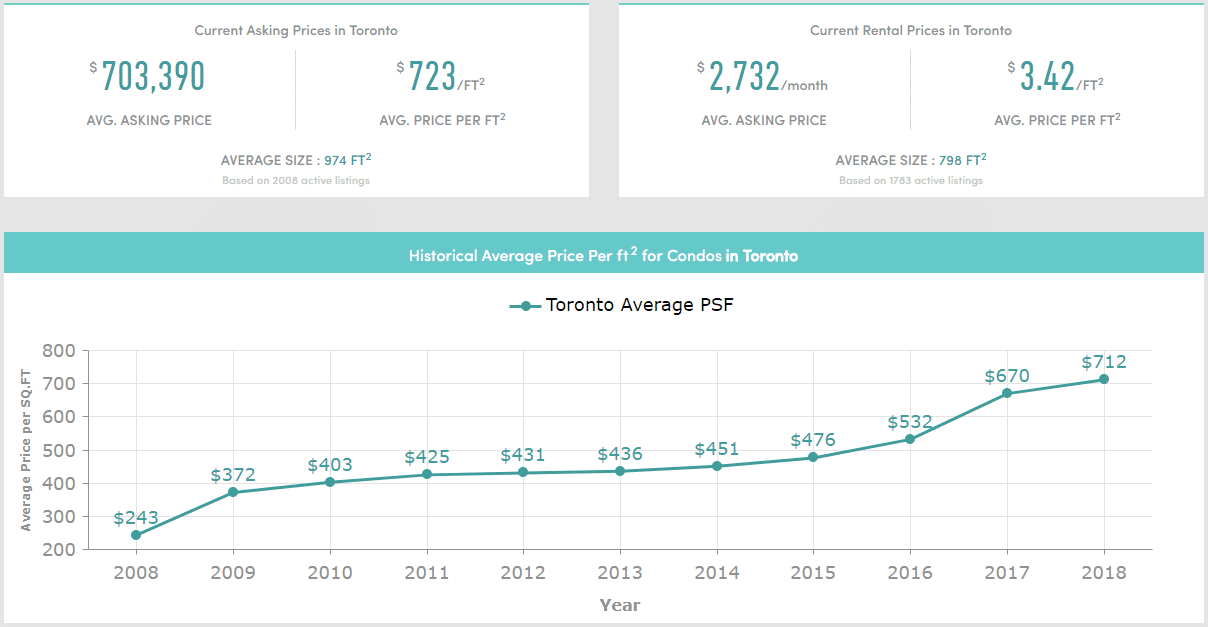
Buying a pre-construction condo with 20% down, or less, allows you to leverage 100% of the asset's appreciation at a five-to-one ratio. Between 1997-2017, the 20-year-over-year average for properties in C01 (downtown Toronto) shows a near 11.56% appreciation before adjusting for inflation.
Remember: Time In The Market > Timing The Market.
FAQs
1. How long does the pre-construction condo process typically take from purchase to completion?
The timeline varies by project, but most pre-construction condos take 2-4 years from initial purchase to final closing. This includes construction time, interim occupancy period, and final registration with the city.
2. What happens if the developer goes bankrupt during construction?
In Ontario, Tarion Warranty Corporation provides protection for buyers. If a builder becomes insolvent, Tarion may complete the project or provide compensation up to certain limits, though this process can be lengthy.
3. Can I get out of a pre-construction condo contract if I change my mind?
Yes, you have a 10-day cooling-off period mandated by Ontario law. After this period, you can still exit through assignment (selling your contract to another buyer) or potentially face penalties outlined in your agreement.
4. How much money do I need upfront for a pre-construction condo?
Typically, you'll need 20% down payment spread over several deposits during construction. The payment schedule varies by developer but often includes deposits at signing, 30 days, 90 days, and at various construction milestones.
5. What are the risks of buying pre-construction condos?
Main risks include construction delays, developer bankruptcy, changes to building specifications, higher-than-expected closing costs, and market conditions changing unfavorably during the construction period.
6. Do pre-construction condos appreciate in value during construction?
On average, pre-construction condos appreciate 5-10% annually between purchase and completion, depending on market conditions and location. However, this isn't guaranteed and varies significantly by market.
So, Are Pre-Construction Condos a Good Investment?
Pre-construction condos may potentially be a good investment. There are multiple factors that go into consideration when investing in a real estate property within the pre-construction market. However, when it comes to a condo investing, the features and amenities prove to have more importance when compared to an individual house. As a buyer, this makes new condos a very attractive proposition.
When you then factor in their excellent locations and transport links, it’s clear to see why condos are such a worthy investment. After all, we all need a place to live. Why not do so in some of the most stunning real estate your city offers?
Have questions about exactly what your condo investment should include? Explore the best pre-construction condos and newly built condos on Precondo.ca.
References:
- https://www.hcraontario.ca/static/f3e92374598485c3944e62386ca3fa94/POTL%20Firm%202020%20-%20Revised%20-%20Final.pdf
- https://www.urbanation.ca/sites/default/files/upload-media/Urbanation-CIBC_Condo_Investment_Report_-_July_2024.pdf

Hey there I’m really confused on the Toronto pre con Market. I was jus wondering if I would be making a mistake in purchasing a pre con 1 bed room unit for a price tag of 625k. Which in essence is roughly 1400sqf which seems kinda of high with comparable pre con developems in the city. I have recently looked into No 31 pre construction building by Lanterra developments. jus wondering if you have any advice. Is there money to be made in the long term with prices as high as they are. Any feed back would be greatly appreciated.
Edit